
The Murder on the Links By Agatha Christie
- Puranjani Ghosh
- Sep 11, 2020
- 3 min read

Updated: Sep 27, 2020
Featuring: The Theme Of The Season "Magic, Mystery & Murders"
This is the second part of the Poirot series by Madame Christie. The plot takes up directly after a certain passage of time from the notorious affair that had happened at Styles, Poirot’s first case which made him well-known to the Londoners. The extreme popularity of that case, courtesy its unexpected turns and aftermath [Check out my review of “The Mysterious Affair at Styles” for references], prompts Hercule Poirot to begin his new occupation as a private investigator. Captain Hastings who lodges with Poirot and works as a secretary to an MP, comes across a strange fellow traveller, ' Cinderella', on his return from Paris.
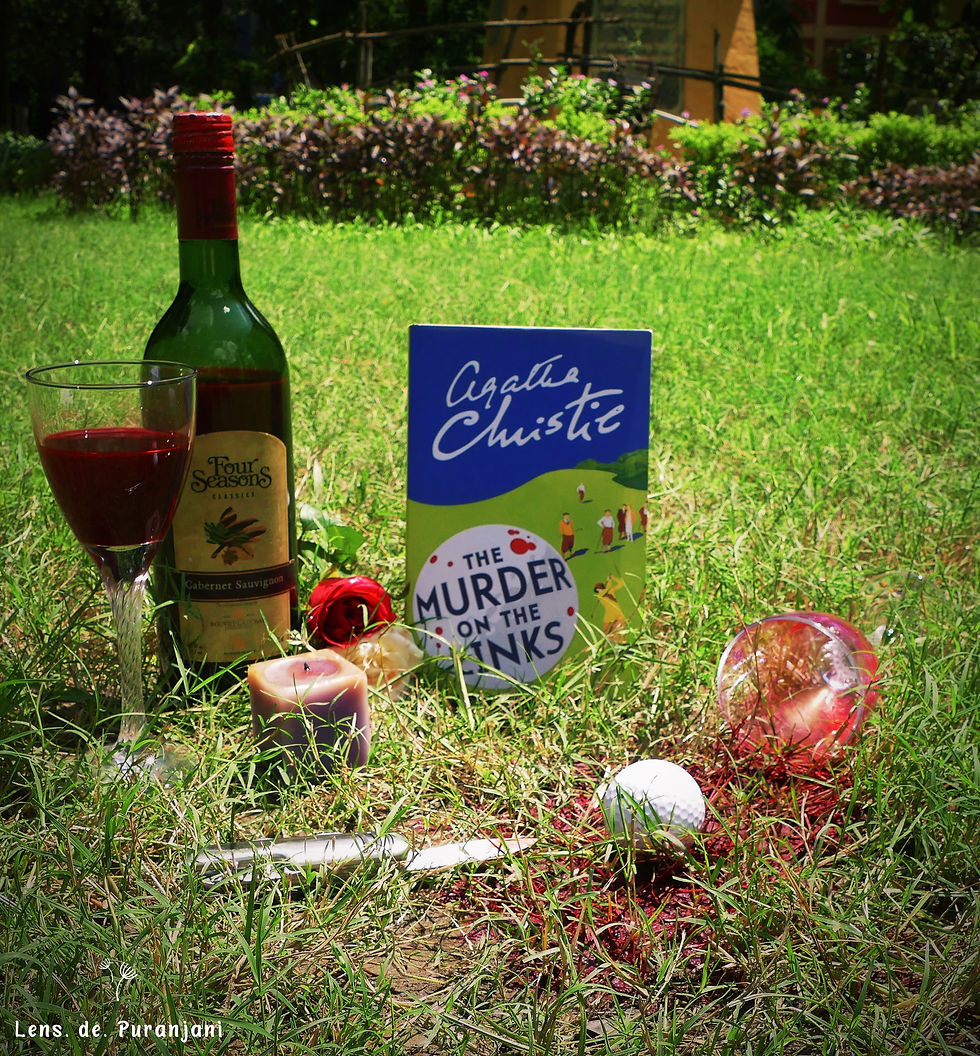
Hastings comes back, flabbergasted, but mostly with mixed sentiments after this strange encounter. Poirot, on the other hand, is slightly bored with the recent cases he has been receiving , most of which are about retrieving lost lap dogs of fashionable ladies. After a little encouragement from Hastings, Poirot opens up his mails and comes across a letter from VILLA GENEVIÈVE by Monsieur Renauld, a renowned South American diamond millionaire. The letter is more like an urgent plea for help. M. Renauld believes his life is endangered and urges Poirot to come to France as soon as possible. He further mentions that Poirot might have to go to Santiago where he spent several years of his life. Unfortunately, Poirot arrives too late to save his client whose brutally stabbed body now lies face downwards in a shallow grave on a golf course. The servants found the main door open and Madame Renauld unconscious in the master bedroom, tied up and gagged. She narrates the police that they were attacked in the middle of the night by two foreign men, possibly native South Americans, her husband was pulled out of bed, threatened to go out with them and that is all she remembers. Their son, Jack, who was sent by his father for an urgent work in Santiago, returns back, immediately, when he hears about the murder. There is also the neighbouring villa, where a mother (Madame Daubreuil) and her daughter live, and their addition to the plot, makes things further interesting.
One of the servants, the eyes and ears of a house, informs Poirot that on that cursed night, a lady had come to visit M. Renauld. Renault was extremely agitated with her and somehow sent her away. The housekeeper claims that it was the Madame from the next villa. In fact in the study room of the deceased, Poirot comes across a torn cheque. The dead man’s overcoat also contains a love letter , which is signed under the name Bella. The son, on the other hand, lies to the police about his whereabouts and simply skips the fact that, before leaving, he had a terrible quarrel with his father regarding an extremely personal matter. Along with these characters, there is also the character of the rude detective Giraud who loathes Poirot's presence and is hell bent on solving the case before him. Soon, another identically murdered body turns up from nowhere in the villa premises, changing the entire flow of the case.
The case is queer because of the excess and peculiar evidences, too many perspectives, and a hell lot of distractions for anyone to dig the truth out of the heap of lies. Another mysterious element is Poirot's ability to relate this case with another similar that had happened long back. Poirot is very completely aware of the oddity, for he is, of the opinion, that the evidences are far too obvious. All he needs, now, is a bit of time. But the oversmart Giraud soon arrests Jack, who denies nothing and is ready to be hanged ; but who is he protecting?
The connection that the author has brought about between the old case and the present one is marvellous and the method of the crime will shock you to your core. The beauty of this plot, like all other Poirot novels, lies in its minuteness and the deliberate misleading to the readers by the author herself, until the final revelation. It is a wonderful and a classic read, enough to make one fall in love with Madame Christie and her funny old detective personalities. It’s interesting to notice that both Poirot and Marple are old people whose quickness of observation and experience of life has made them who they are today - legendary investigators. Afterall, as Poirot says, “The true work, it is done from within. The little grey cells – remember always the little grey cells, mon ami.”


Thank you 😊 @rajitabhowal77 ❤️❤️
Oh yes....ma sœur !! @csaha1708 ...elle édités pour moi à certains temp... Mais c'est elle a édité !
qui d'autre édite pour vous?
@csaha1708, je ne comprends pas toi question...
And ofcourse....it's you vivek !! -_- but I take it as a compliment 😂