
Paris Mysteries By Edgar Allen Poe
- Puranjani Ghosh
- Sep 18, 2020
- 3 min read

Updated: Sep 27, 2020
Featuring: The Theme Of The Season "Magic, Mystery & Murders"
“Where was the detective story until Poe breathed breath of life into it?”
- Arthur Conan Doyle.
Set in 19th century, “Paris Mysteries” is a compilation of three different stories
narrating the detailed investigations of C. Auguste Dupin. He is considered as
the first detective protagonist who later, inspired the creation of his
successors, Sherlock Holmes (Late 19th Century) and Poirot (20th Century).
There are three short stories: “The Murders in the Rue Morgue”, “The Mystery
of Marie Roget” and “The Purloined Letter”, all happening in Paris.
The first two are astonishingly amazing and the last one is more or less good, but nothing compared to the first two. In fact the second story “The Murder of Marie Roget” is actually based upon a true incident, a brutal murder of a young girl that happened in a neighborhood in New York and the investigations were actually ongoing when Poe published the story (1842). Through Dupin’s speculations, Poe has elaborately explained certain perspectives of the case that the press and the police tried to exaggerate and wrongfully claim. Although he fails to apprehend the real criminals but the way he curves out a different angle of the case, based on the facts makes this story a must read. A beautiful and young shop girl who left her mother’s house on Sunday to visit her aunt had never returned back home (nor was received by her aunt) until her corpse appeared to be dragged out of the Seine on a Wednesday.

“The Murders in Rue Morgue” is about the gruesome killings of a mother and a daughter, whose bodies were discovered by the neighbors in their apartment that had turned into a charnel house. The case is a very unique one, the neighbors did hear the two perpetrators as they were on their way to the top floor of the building where the family lived but only one of the perpetrators was identified as a French man and the other’s language was simply a mystery. A Spanish man called it French, the French called it Spanish, some said it was Italian and the Italian witness referred to it as German whereas the German neighbor simply said it might have been something else. There was neither an ingress nor an egress of the crime, In fact the bodies were mauled and weirdly killed, something that appeared very inhuman. To be honest, this has been my favorite out of the three.
The last story is about a political blackmail. A case taken up at the request of the Police Prefecture of Paris, involving an over-smart minister who tried to act beyond his bounds but his charades were up only until Dupin came along and brought down a hilarious end to his stupid plan.
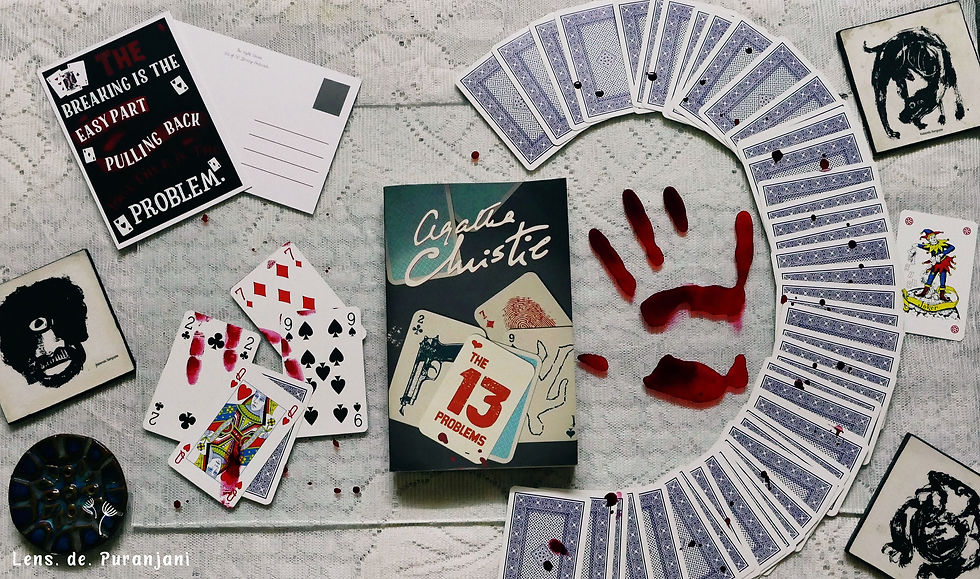
Dupin is neither a professional private investigator nor he comes from a police background. He is someone with extreme skills of observation and a deft knowledge of human behavior. To anyone who has previously read Holmes and Poirot, would actually find Dupin a bit primitive for Poe was only able to write Dupin’s early cases before the author’s untimely death. In fact I very much believe that if Poe lived longer, he would definitely have transformed these short stories into a long chain of series. Dupin is more like an outsider, watching the crime scene from afar, looking at the bigger picture and leaving the groundwork for the police and the press. In fact there is no interrogation of suspects as one usually finds in a detective novel, but I did find it similar with “13 Problems” by Agatha Christie, which is also another compilation of stories of Miss Maple’s early cases.There too, Miss Maple only heard the incidents that happened long back and neither interrogation nor presence in the scene of crime was required for her to solve the mysteries.
Dupin’s approach is very analytical and based on thorough research of newspapers and police reports.To a great extent,he shows traces of a modern day code breaker, with the vibe of ‘playing chess in the dark’ and with his almost accurate speculations. The narrator is the unnamed accomplice, probably the writer himself!
One is sure to love the latent tone of sarcasm throughout the pages and the vivid description of the crime sequences that could transport you to the scene itself. Any person who will read this book is bound to remember the strangeness of the first two stories, long after they have finished it, believe me it is so true, their gory details will to some extent even haunt you. For any suspense lover, this is very ideal and one must always know why Poe is known as the godfather of thriller and mysteries.

Thank you so much!! @rajitabhowal177
😍♥️